
Resource Profiles
New Resource Search
← Return to Find Resources | MTSS
Resource Results
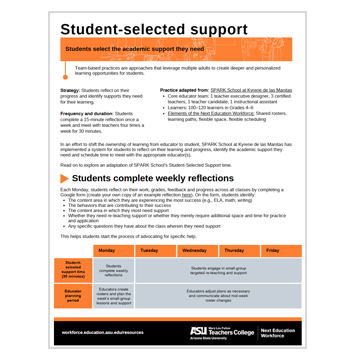
Student-Selected Support
Learn how to implement a secondary support strategy where students reflect on their progress and select the 30-minute Student-Selected Support periods they need four days a week.
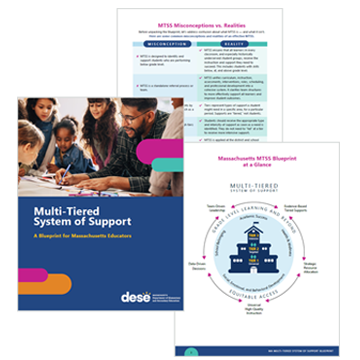
2025 Massachusetts MTSS Blueprint
The updated 2025 Massachusetts MTSS Blueprint unpacks MTSS from three perspectives: why it is important, what it entails, and how to approach implementation. It reflects a holistic view of student development and MTSS implementation lessons from the field and research.
Multi-Tiered System of Supports for Multilingual Learners
The guide addresses a critical gap in traditional school models: the tendency to misidentify language acquisition as a learning disability and over-refer MLs for special education services. It advocates for a culturally and linguistically-aligned lens to ensure that multilingual learners receive support that respects their primary language and cultural background.
Multi-Tiered Supports through Early Warning Systems (High School)
This resource focuses on implementing early warning systems, with a focus on the “ABCs” (absenteeism, behavior referrals, and course failure) which are highly predictive indicators for dropping out. Includes staffing, scheduling, and other resource shift examples, and highlights “do now” and “build toward” practices.
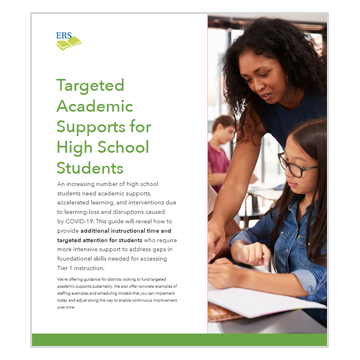
Targeted Academic Supports for High School Students
This guide focuses on ways high schools can provide additional instructional time and targeted attention for students who need more intensive support. It focuses on two of four primary models — flex blocks and “double dose” courses — with concrete examples of scheduling, staffing, and resource allocation strategies for the two featured approaches. The guide also provides links to resources on two other promising practices — acceleration academies and high dosage tutoring.
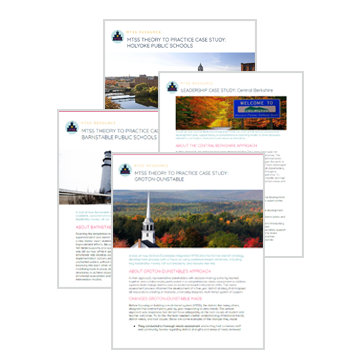
MTSS District Theory to Practice Case Studies
Explore different shifts and improvements four districts made in order to implement a stronger MTSS approach. These case studies are based on interviews with leaders from each district in early 2020 after 1-3 years of MTSS implementation (varied by district). The case studies include discussion questions teams can use to unpack strategies and lessons learned.
Unlocking Algebra: What the Data Tells Us About Helping Students Catch Up
This report explores the question: “How can we help more students master Algebra I, especially those who start the course with significant unfinished learning?” It is based on a TNTP analysis of three years of data from more than 2000 math students and explores practice strategies for integrating Tier 2 supports into daily instruction.
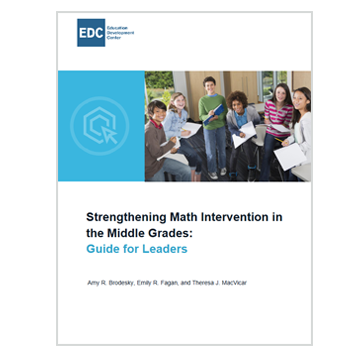
Strengthening Math Intervention in the Middle Grades: Guide for Leaders
This guide helps math leaders in different roles and at different stages of math intervention, from getting started to leading an established program. It includes sections on identifying students, scheduling, class size, staffing, and other aspects of implementing math intervention classes.
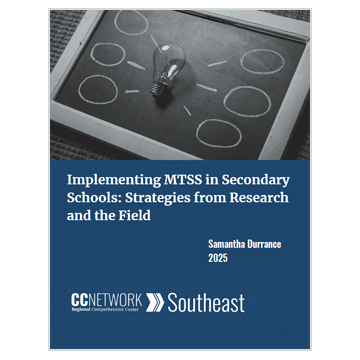
Implementing MTSS in Secondary Schools
Practical strategies to address logistical and instructional challenges secondary schools often encounter implementing MTSS including intervention blocks, scheduling, teaming, and other practices. The 2022 report focused on early implementation. The 2025 report updates and extends the toolkit of strategies and includes additional resources and examples. It also expands the focus of MTSS to include student well-being.
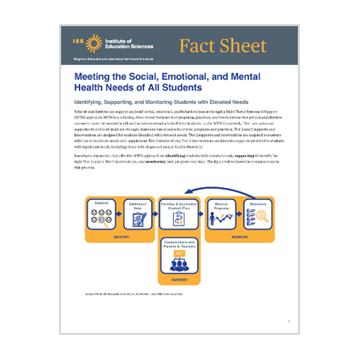
Using MTSS to Support Student Well-Being: Fact Sheets for Schools
Use this series of fact sheets to refine tiered supports for student social emotional development and mental wellbeing. Topics include the research basis, student identification, data use, and educator wellbeing.

Mass Literacy Guide
Find evidence-based practices and resources for supporting literacy in PK-3 classrooms.
SchoolHouse Connection - Tools & Resources
A treasure trove of resources for school staff, youth, and families including tip sheets and training tools, webinars, “Know Your Rights” flyers, postsecondary transition support tools, and much more.
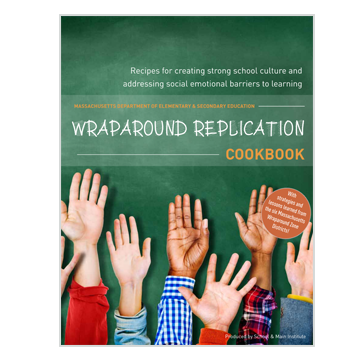
Wraparound Replication Cookbook: Recipes for Creating Strong School Culture and Addressing Social Emotional Barriers to Learning
This cookbook is the result of the Massachusetts Wraparound Zone Initiative, an initiative aimed at helping schools tackle both academic and non-academic barriers to student learning, and includes recipes for strengthening school culture, creating strong student success teams, engaging family members as partners, building community partnerships and coalitions, and much more.
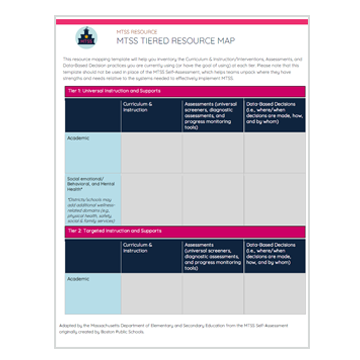
MTSS Tiered Resource Map
This resource mapping template will help you inventory the Curriculum & Instruction/ Interventions, Assessments, and Data-Based Decision practices you are currently using (or have the goal of using) at each tier.

Online TAP Social Emotional & Behavioral Health Training Series - Boston Children’s Hospital
These free training modules for educators are part of the Clough Foundation Training and Access Project (TAP) Online series, which offers free courses designed to build the capacity of school communities to address social-emotional learning and behavioral health. TAP is a part of the Boston Children’s Hospital Neighborhood Partnerships Program (BCHNP).
Supporting and Responding to Students’ Social, Emotional, and Behavioral Needs: Evidence-Based Classroom Strategies for Educators
Concise guide - updated in 2025 - that provides positive behavior support practices, a self-assessment tool and classroom decision-making chart, and classroom-based practice examples organized by topic, e.g., setting expectations, developing routines, using behavior-specific praise, responding to problem behavior, collecting and using behavior data, etc.

Innovating to Support Student Success: P.K. Yonge School Case Study
Learn how the P.K. Yonge School in Florida structured its tiered systems of support approach. The case study includes information on how "Student Success Teams" are organized and run, how "tiering" is done, and how the staff take an integrated view of academic and social emotional or behavioral support needs.

PEAR Holistic Student Assessment (HSA)
The PEAR Holistic Student Assessment (HSA) is a universal social-emotional assessment tool (student survey) that can help you better understand each student's unique strengths and needs.
← Return to Find Resources | MTSS