Welcome to Kindergarten: A Planning Toolkit for Massachusetts' Schools, Families, and Communities

Use this toolkit to help early childhood care providers, families, and schools support the transition to Kindergarten. Available in English, Cape Verdean Creole, Haitian Creole, Portuguese, Chinese, and Vietnamese.

Resource Link

Source

Massachusetts Department of Early Education and Care and Massachusetts Department of Elementary and Secondary Education

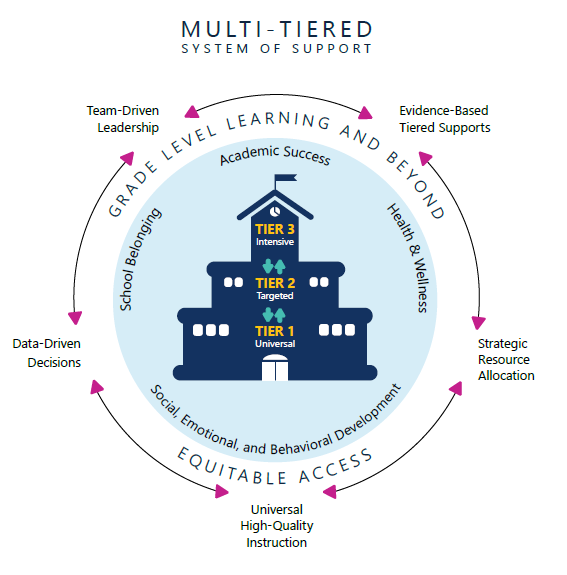
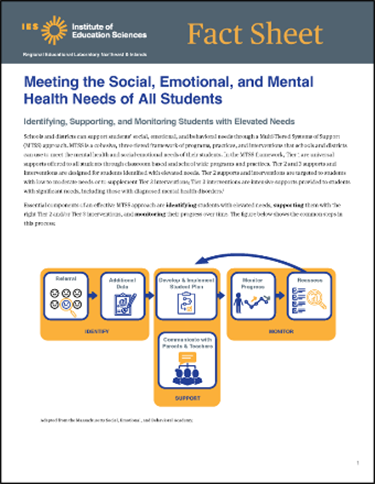
2019 MTSS Leadership Institute Materials

Multi-Tiered System of Support Leadership Institute Poster.

Note: The MTSS Blueprint was updated in 2025.

Welcome to the September 26 & 27th MTSS Leadership Institute. This professional development opportunity focused on giving district teams the opportunity to learn about the new MTSS blueprint and discuss how to lead within an MTSS framework. Please see below for breakout session material links.

Resource Links

Source

Massachusetts Department of Elementary and Secondary Education


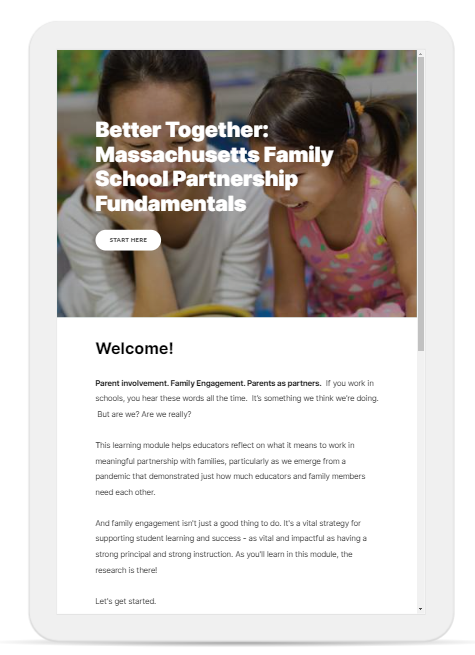
Better Together: Massachusetts Family School Partnership Fundamentals Training Module

Creating strong partnerships with families isn’t just a good thing to do. It’s a vital strategy for helping students succeed - as impactful as having a strong principal and strong instruction.

The Better Together online training module developed by MA DESE helps educators think about and do family partnership. You will learn about the Massachusetts Family, School, and Community Partnership Fundamentals, hear from family members, and explore strong family partnership practices.

The module also provides a Fundamentals Reflection Process Tool Kit which school and district teams can use to identify the next stage or level of family school partnership in the district.

Resources

Here are a few of the tools you’ll find in the training module:

Source

Massachusetts Department of Elementary and Secondary Education

Wraparound Replication Cookbook: Recipes for Creating Strong School Culture and Addressing Social Emotional Barriers to Learning

This cookbook is the result of the Massachusetts Wraparound Zone Initiative - an initiative aimed at helping schools tackle both academic and non-academic barriers to student learning.  A rigorous evaluation of the Massachusetts Wraparound Zone Initiative (5 districts, 30 schools) conducted by the American Institutes of Research found that wraparound strategies made a significant contribution to improved student outcomes, particularly those related to student behavior, student support, and family engagement. This handbook represents the best thinking and strategy "recipes" on how to support the social emotional aspects of learning:

  • Addressing school culture and the social emotional aspects of learning

  • Rethinking systems for holistically identifying and addressing student academic and social emotional needs

  • Creating focused partnerships and coalitions

  • Treating parents as full partners

  • Big district and state takeaways

  • How to get started and how to manage priorities coherently

  • Profiles of six districts and the strategies they used

  • Links to resources, tools, templates and more

Resource Links

Wraparound Zone Cookbook

Individual Recipes

  1. Doing a Welcoming School Walkthrough

  2. Creating a School Culture Team

  3. Rethinking Recess

  4. Students as Culture Builders

  5. Assessing Student Strengths & Needs

  6. Student Success Teams (Student Support Teams, Child Study Teams, Whole Child Support Teams)

  7. Mobilizing around a Tiered System of Supports Framework

  8. Tracking Student Support

  9. Mapping Your Resources

  10. Creating Deep Wraparound Partnerships

  11. Managing Partnership Development at Your School

  12. Organizing as a Coalition of Partners

  13. Academic Parent Teacher Teams

  14. Parent House Parties | Academic Support Parties

  15. Rethinking Parent Academies and Cafes: Pooling Community Resources

Wraparound Video Series - hear Mass educators, students, staff, parents and partners highlight their strategies and the impact

Source

Massachusetts Department of Elementary and Secondary Education and School & Main Institute

Safe and Supportive Schools Self-Reflection Tool

Multi-Tiered System of Support Leadership Institute Poster.

Welcome to the revised Safe and Supportive Schools Implementation Guide & Self-Reflection Tool. The goal of the self-reflection Tool is to catalyze a reflective and creative inquiry-based, year-long or multi-year process to create and enhance a school`s work to become more safe and supportive for the entire school community (including but not limited to: students, staff, families, and community partners). This tool is intended to assist with documenting current practices that support students` behavioral health ranging from the whole school community to individual students that require more intensive supports. It also examines the role of various school professionals and staff in providing these supports. This process enables schools to identify their most pressing local priorities and create action plans that can be incorporated into School Improvement Plans to address these priorities. It may be helpful to revisit your school`s responses to this tool on a regular (e.g., quarterly, annual) basis to review progress and continually work towards full implementation on a range of practices that address and remove the barriers to learning.

Resources

Safe and Supportive Schools Self-Reflection Tool

Source

Massachusetts Department of Elementary and Secondary Education

Conditions for Learning Surveys

Sample question from Conditions for Learning Survey.

The Conditions for Learning surveys (CFL) were developed collaboratively and field-tested by districts and Massachusetts Department of Elementary & Secondary Education staff involved in the Urban Leaders Network for School Climate & Student Support. The CFL metric and survey tools focus on the holistic “conditions” (including social emotional learning) students need in order to learn in a school setting. The CFL contains surveys around the following domains: school climate, academic engagement, social emotional learning, parent & family engagement, and systems of student support, with surveys for students, staff, and families. Schools and districts are welcome to utilize these survey tools.

Resource Links

Conditions for Learning Surveys

Source

Massachusetts Department of Elementary and Secondary Education with School & Main Institute
 

The Dual Capacity-Building Framework for Family-School Partnerships

Based in existing research and best-practices, this guide provides a compass for the development of family engagement strategies, policies, and programs using a "dual capacity" approach that recognizes the roles and needs of both partners - parents and staff. For those doing family engagement work, this is one of the main go-to frameworks for thinking about this work.

Resource Links

A Dual Capacity-Building Framework for Family-School Partnerships

Source

SEDL:  Advancing Research Improving Education, U.S. Department of Education